
News
News
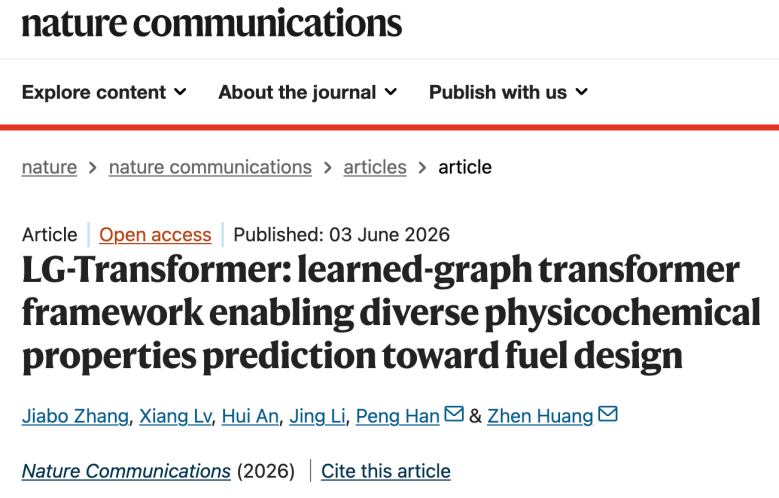
Recently, the research team led by Academician Zhen Huang at the School of Mechanical Engineering, Shanghai Jiao Tong University, has made important progress in AI-enabled green fuel design. The team proposed LG-Transformer, a learned-graph Transformer framework that enables accurate and unified prediction of diverse physicochemical properties of fuels, providing a new tool for rapid screening and intelligent design of green fuels.
The research achievement, titled “LG-Transformer: Learned-Graph Transformer Framework Enabling Diverse Physicochemical Properties Prediction toward Fuel Design,” has been published in Nature Communications. Associate Professor Jiabo Zhang from Shanghai Jiao Tong University is the first author. Professor Zhen Huang from Shanghai Jiao Tong University and Professor Peng Han from Xi’an Jiaotong University are the co-corresponding authors.
Green fuels are essential to low-carbon transportation and carbon neutrality. However, identifying fuels that best meet engine requirements is a complex multi-objective challenge. Fuel performance depends on coupled properties related to spray, ignition, combustion and emissions, while the candidate fuel space may involve thousands of molecular systems. Rapidly and reliably predicting multiple key properties has therefore become a critical issue in fuel design.
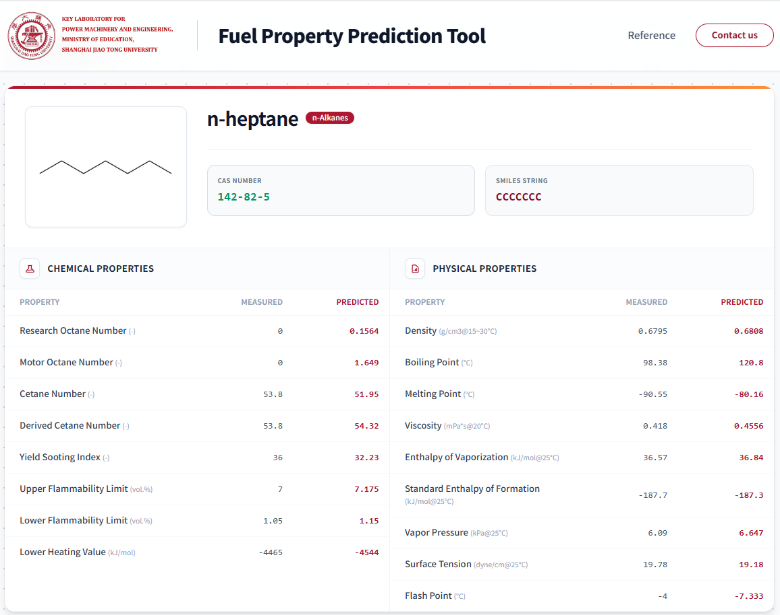
To address this challenge, the team first built a high-quality fuel property database covering 17 key physicochemical indicators, including research octane number, motor octane number, cetane number, density, viscosity and surface tension. Based on this database, the team also developed an open AI for Fuel Design platform, which supports searches by molecule name, CAS number or SMILES structure and provides multidimensional property data with literature references.
Unlike conventional methods that mainly analyze individual molecules independently, LG-Transformer introduces a learned graph to capture property-related relationships among molecules. By combining this learned graph with Transformer-based modeling, the framework can learn complex dependencies among high-dimensional molecular features and predict multiple fuel properties within a unified model.
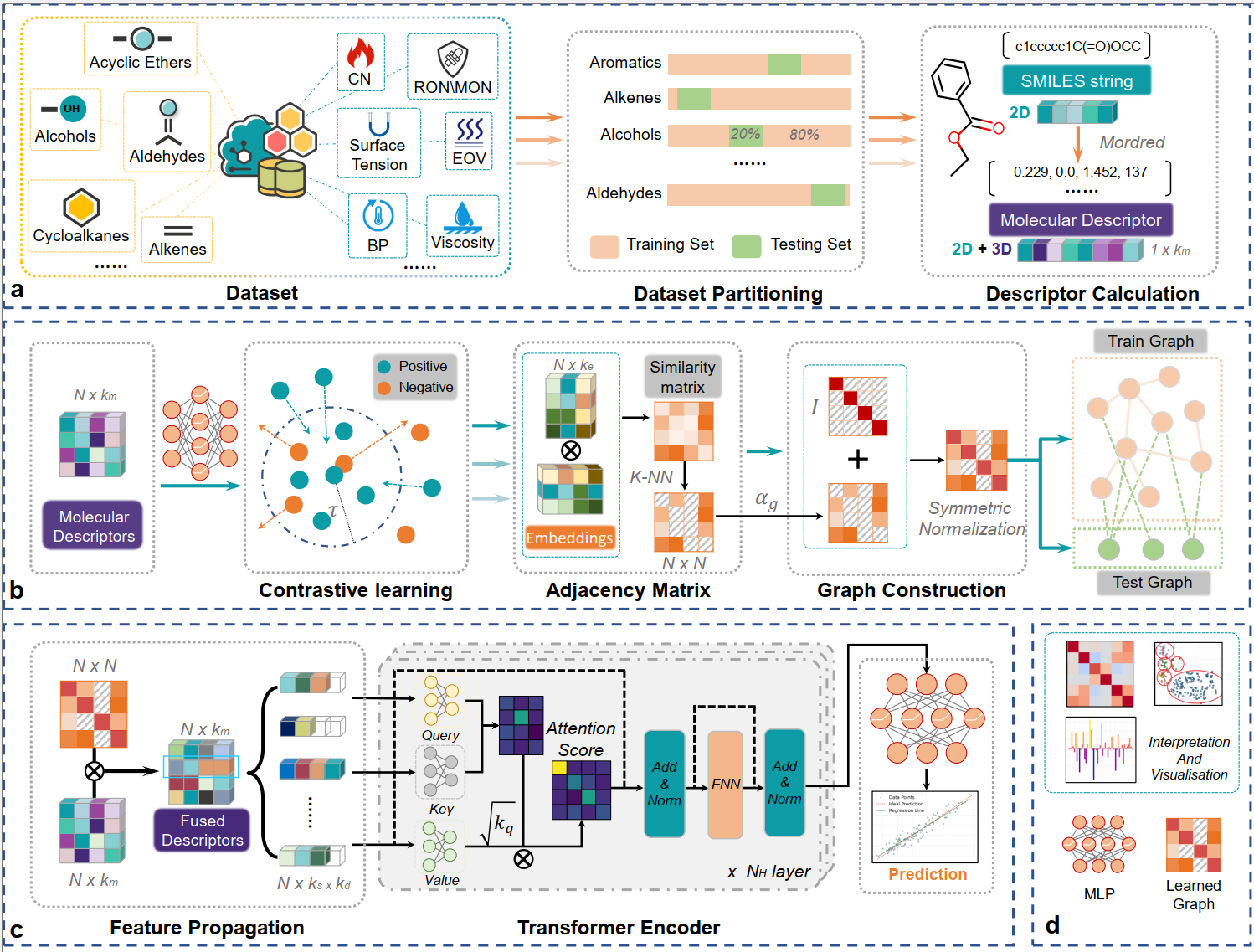
The framework achieved strong performance across 17 fuel-property prediction tasks and outperformed existing machine learning models overall. It also maintained reliable accuracy for fuel subcategories with limited samples, demonstrating strong adaptability and generalization. In an independent test set of 260 new fuel molecules not used in training, LG-Transformer continued to show high predictive accuracy.
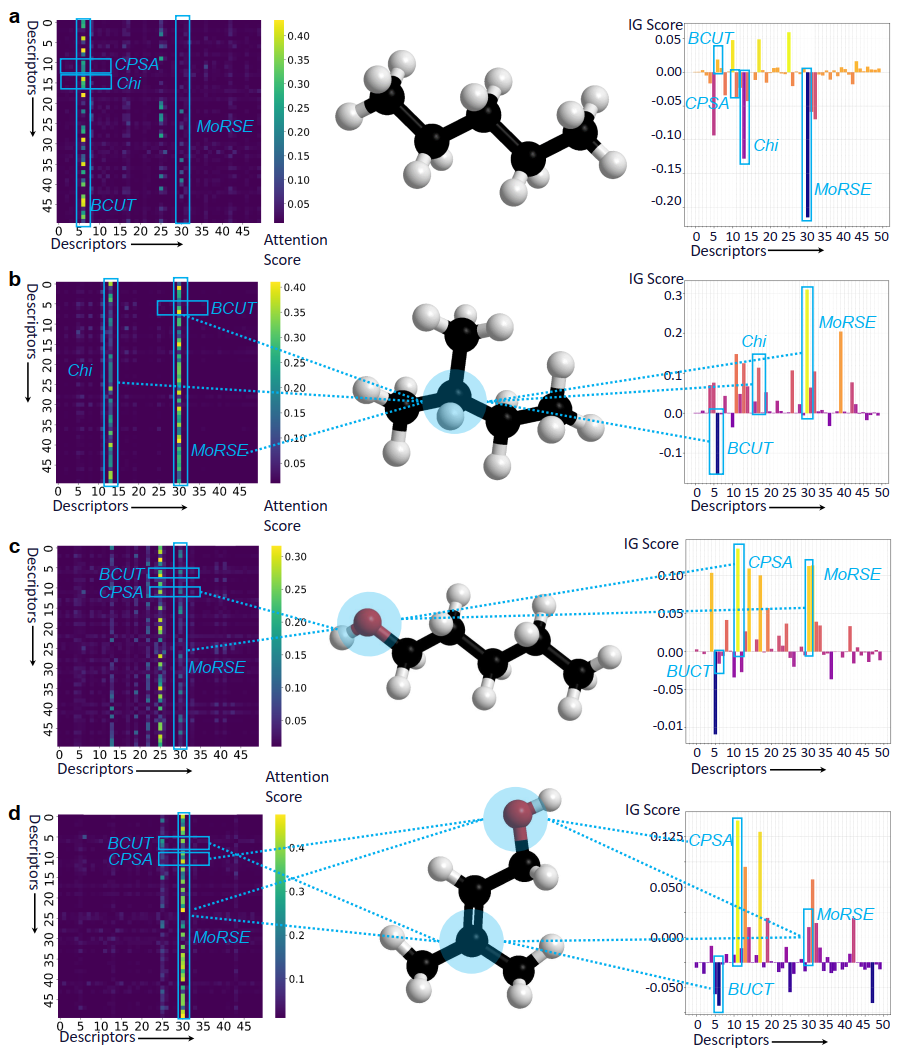
Beyond accuracy, the team emphasized interpretability. By integrating attention mechanisms and Integrated Gradients, the framework can help explain how molecular descriptors contribute to property predictions. For example, in motor octane number prediction, the model identified the effects of branching structures, polar functional groups and electronic distribution, which are consistent with established knowledge in combustion chemistry and physical chemistry.
This study offers a new AI-driven approach for screening and designing green fuels, including zero-carbon ammonia and hydrogen, green alcohols and ethers, and renewable synthetic fuels. It also highlights the potential of AI for Energy to shift fuel research from experience-driven exploration toward data-driven and intelligence-driven design.
This research was supported by the Major Program of the National Natural Science Foundation of China, the Shanghai-Yunnan Science and Technology Collaborative Innovation Program, and the Shanghai Pujiang Talent Program.
Paper link: https://www.nature.com/articles/s41467-026-73853-z
AI for Fuel Design database: https://ai4fuel.sjtu.edu.cn/

Shanghai Jiao Tong University
Address: 800 Dongchuan Road, Shanghai
200240