
News
News
Recently, the research team led by Associate Professor Daozhi Shen from School of Mechanical Engineering, SJTU, published a research paper in Science Advances, titled “Moisture-driven, self-powered noncontact sensing interfaces via turbulence-tailored hygroelectronic effect”. In this work, they have developed a novel human-machine interface that uses moisture-generated electricity to recognize hand gestures with remarkable precision from up to 8 centimeters away. This technology allows users to control devices, input passwords, and interact with virtual reality simply by moving their hands in the air, without any batteries or physical contact.
A New Paradigm: From Power Source to Functional Interface
“We wanted to explore the functional potential of moisture-based power generation. Using it for contactless, touch-free interaction is a significant transition from a power supply component to a functional component—a truly meaningful attempt,” said Associate Professor Shen.
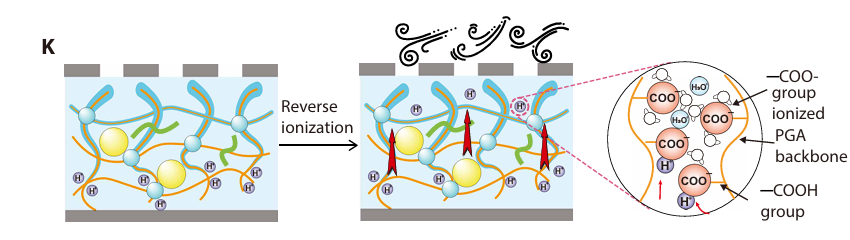
The technology is based on the principle of moisture-based power generation. The team engineered an 80-micrometer-thick hydrogel film composed of polyglycolic acid (PGA), cellulose nanofibers (CNF), salts, and organic acids. This film is filled with micro-pores that spontaneously absorb water molecules from the ambient air. When the hydrogel absorbs moisture, carboxylic acid groups (-COOH) dissociate, releasing free hydrogen ions (H+) and creating an ion concentration gradient that generates voltage and current. The team discovered a new physical mechanism called turbulence-regulated hygroelectric effect. When a finger moves within a few centimeters of the device, it creates local air turbulence. This turbulence causes a temporary decrease in surface humidity and a slight increase in air pressure, which together produce characteristic voltage fluctuations.
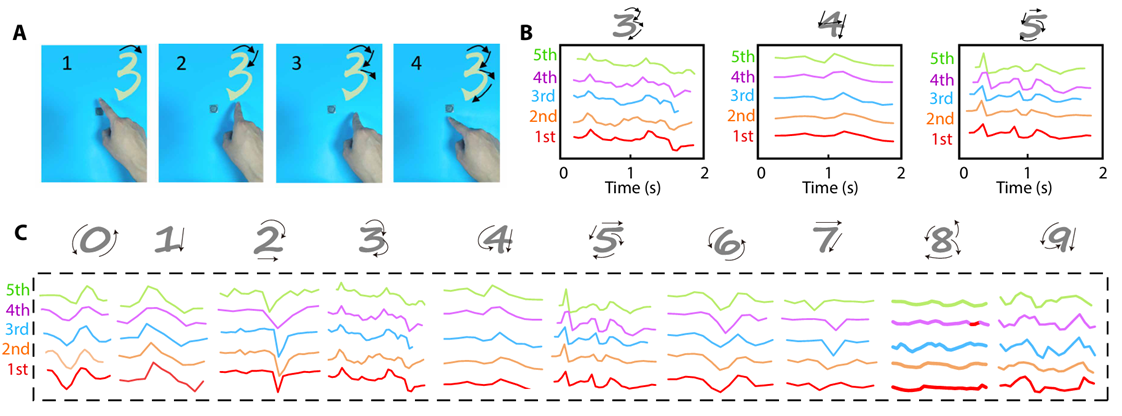
These fluctuations are unique to each gesture. For example, writing the number "0" in the air generates a waveform with two peaks and two valleys, while writing "1" produces a single peak and valley. Crucially, these signals remain stable even when the device is 2 to 8 centimeters away from the hand and within an ambient humidity range of 30% to 70%.
High Accuracy and Real-World Validation
The team used two machine learning models, a 1D convolutional neural network (1D-CNN) and a support vector machine (SVM), to decode these signals. Even with only about 20 training samples per gesture, the 1D-CNN achieved a 91.5% recognition accuracy for the digits 0-9, while the SVM model reached an astonishing 99% accuracy.
The technology's potential was validated in three key scenarios:
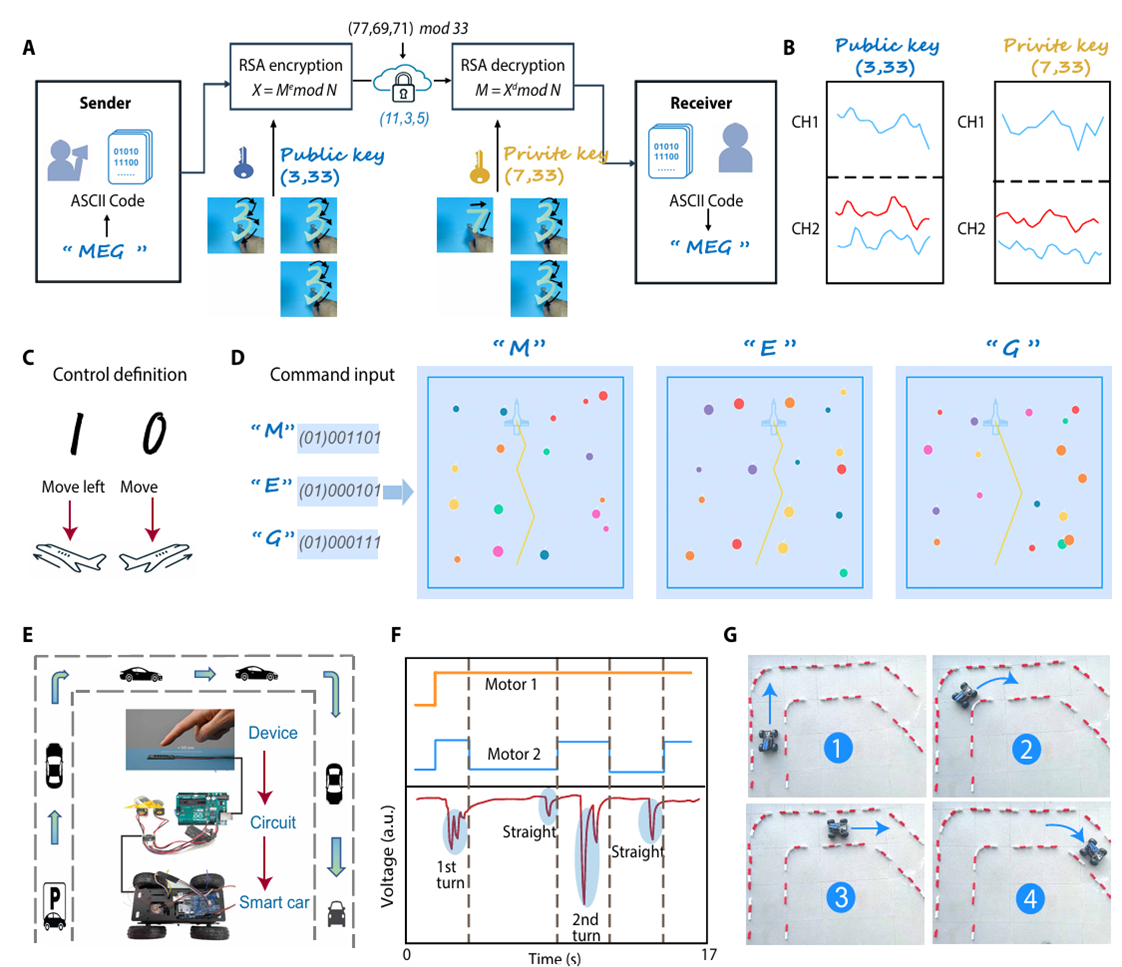
Encrypted Information Transfer: The system enables a completely contactless method for entering encryption keys, eliminating the physical wear and security risks associated with traditional keypads. In a proof-of-concept, users input RSA encryption keys through gesture alone.
Virtual Reality and Gaming: In a flight obstacle avoidance game, users could steer a virtual plane by writing digits in the air, showcasing the system's high accuracy and responsiveness.
Real-World Remote Control: The sensor was connected to a micro-controller and a smart car. Users could control the car's movement (e.g., writing "1" to go straight, "11" to turn right) through a series of non-contact commands.
From initially observing the phenomenon of moisture power generation in 2016 to this current breakthrough, Associate Professor Shen and his team have spent a decade refining this technology. The team's future work will focus on transitioning the device from the laboratory to more complex, real-world environments and integrating this zero-power, contactless technology with embodied intelligence and human-machine interaction. Their research findings have been published in prestigious journals including Science Advances, Advanced Materials, and Energy & Environmental Science.
Paper link:https://www.science.org/doi/10.1126/sciadv.aee7050

Shanghai Jiao Tong University
Address: 800 Dongchuan Road, Shanghai
200240